







Isogonal conjugate
Isogonal conjugates are pairs of points in the plane with respect to a certain triangle.
Contents
[hide]- 1 The isogonal theorem
- 2 Parallel segments
- 3 Perpendicularity
- 4 Fixed point
- 5 Bisector
- 6 Isogonal of the diagonal of a quadrilateral
- 7 Isogonals in trapezium
- 8 Isogonals in complete quadrilateral
- 9 Isogonal of the bisector of the triangle
- 10 Points on isogonals
- 11 Trapezoid
- 12 Definition of isogonal conjugate of a point
- 13 Three points
- 14 Second definition
- 15 Distance to the sides of the triangle
- 16 Sign of isogonally conjugate points
- 17 Circumcircle of pedal triangles
- 18 Common circumcircle of the pedal triangles as the sign of isogonally conjugate points
- 19 Two pares of isogonally conjugate points
- 20 Circles
- 21 Equidistant isogonal conjugate points
- 22 Simplified distance formula for isogonal points
- 23 Point on circumcircle
- 24 Fixed point on circumcircle
- 25 Distance formula for isogonal points
- 26 Miquel point for isogonal conjugate points
- 27 Point on circumcircle
- 28 Isogonal of line BC with respect to angle BAC
- 29 Isogonal bijection lines and points
- 30 Miquel point for two pare isogonal points
- 31 Isogonic center’s conjugate point
- 32 Three pairs isogonal points
- 33 Ratio for three pairs of isogonal points
- 34 Problems
The isogonal theorem
Isogonal lines definition
Let a line  and a point
  lying on be given. A pair of lines symmetric with respect to and containing the point be called isogonals with respect to the pair
Sometimes it is convenient to take one pair of isogonals as the base one, for example,  and
and  are the base pair. Then we call the remaining pairs as isogonals with respect to the angle
Projective transformation
It is known that the transformation that maps a point with coordinates  into a point with coordinates
  is projective.
If the abscissa axis coincides with the line and the origin coincides with the point  then the isogonals define the equations
  and the lines
  symmetrical with respect to the line become their images.
It is clear that, under the converse transformation (also projective), such pairs of lines become isogonals, and the points equidistant from lie on the isogonals.
The isogonal theorem

Let two pairs of isogonals  and
and  with respect to the pair
  be given. Denote
Prove that  and
and  are the isogonals with respect to the pair
Proof

Let us perform a projective transformation of the plane that maps the point into a point at infinity and the line maps to itself. In this case, the isogonals turn into a pair of straight lines parallel to and equidistant from 
The converse (also projective) transformation maps the points equidistant from onto isogonals. We denote the image and the preimage with the same symbols.
Let the images of isogonals are vertical lines. Let coordinates of images of points be ![\[X(-a, 0), X'(a,u), Y(-b,v), Y'(b,w).\]](http://latex.artofproblemsolving.com/1/c/c/1cc36b9188dedd7b93c1644c37321dcd1d73a033.png) Equation of a straight line
Equation of a straight line  is
is 
Equation of a straight line  is
is 
The abscissa  of the point
  is
is 
Equation of a straight line  is
is 
Equation of a straight line  is
is 
The abscissa  of the point
  is
is 
Preimages of the points and lie on the isogonals. 
The isogonal theorem in the case of parallel lines

Let  and
and  are isogonals with respect
Let lines and intersect at point 
Prove that and line  through parallel to are the isogonals with respect
Proof
The preimage of is located at infinity on the line 
The equality  implies the equality the slopes modulo of and to the bisector of
Converse theorem

Let lines and intersect at point
Let and be the isogonals with respect
Prove that and are isogonals with respect 
Proof
The preimage of is located at infinity on the line  so the slope of is known.
Suppose that 
The segment and the lines  are fixed
 intersects at
but there is the only point where line intersect  Сontradiction.
vladimir.shelomovskii@gmail.com, vvsss
Parallel segments

Let triangle  be given. Let
  and
and  be the isogonals with respect
  Let
Let 
Prove that  lies on bisector of
  and
and 
Proof
Both assertions follow from The isogonal theorem in the case of parallel lines
vladimir.shelomovskii@gmail.com, vvsss
Perpendicularity

Let triangle be given. Right triangles  and
and  with hypotenuses and are constructed on sides
  and
and  to the outer (inner) side of
  Let
Let  Prove that
Proof
Let be the bisector of 
and are isogonals with respect to the pair 
and are isogonals with respect to the pair 
 and
and  are isogonals with respect to the pair
  in accordance with The isogonal theorem.

is the diameter of circumcircle of
Circumradius and altitude are isogonals with respect bisector and vertex of triangle, so
vvsss
Fixed point

Let fixed triangle be given. Let points  and
and  on sidelines
  and
and  respectively be the arbitrary points.
Let  be the point on sideline such that
 Prove that line
  pass through the fixed point.
Proof
We will prove that point  symmetric
  with respect
  lies on .
 and
and  are isogonals with respect to
 points and
  lie on isogonals with respect to
  in accordance with The isogonal theorem.
Point  symmetric with respect lies on isogonal with respect to
  that is
vvsss
Bisector

Let a convex quadrilateral  be given. Let
  and
and  be the incenters of triangles
  and
and  respectively.
Let  and
and  be the A-excenters of triangles and respectively.
Prove that  is the bisector of
Proof

 and
and  are isogonals with respect to the angle
 and
and  are isogonals with respect to the angle
  in accordance with The isogonal theorem.
Denote 
WLOG, 
![\[\angle ACJ = \angle ACE + \alpha = \beta,\]](http://latex.artofproblemsolving.com/a/e/6/ae6bfeff708215f27e1593191d70268c82c62967.png)
![\[\angle BCE = 2 \alpha + \beta - \alpha = \alpha + \beta = \angle DCE. \blacksquare\]](http://latex.artofproblemsolving.com/a/e/c/aecc3efb0ddd6e8d05f8fdc4209902b67ac6ba82.png)
vvsss
Isogonal of the diagonal of a quadrilateral

Given a quadrilateral and a point on its diagonal such that 
Let 
Prove that 
Proof

Let us perform a projective transformation of the plane that maps the point to a point at infinity and the line  into itself.
In this case, the images of points  and are equidistant from the image of
the point  (midpoint of
  lies on
contains the midpoints of and 
is the Gauss line of the complete quadrilateral  bisects
the preimages of the points and lie on the isogonals  and
and 
vvsss
Isogonals in trapezium

Let the trapezoid  be given. Denote
 ![\[B = AE \cap CF, D = AF \cap CE.\]](http://latex.artofproblemsolving.com/2/8/c/28c6cf4a176ca46dca6fc1764b9cc66f531a4579.png)
The point on the smaller base is such that 
Prove that 
Proof
![\[EM = MF \implies\]](http://latex.artofproblemsolving.com/a/9/3/a933e7b7c71ee9c9a56bd0f8635fe88343387387.png)
![\[\angle AME = \angle MEF = \angle MFE = \angle CMF.\]](http://latex.artofproblemsolving.com/9/4/3/9433fc9466072c56d873d1f96a6dcc41d279c255.png) Therefore
Therefore  and
and  are isogonals with respect
Let us perform a projective transformation of the plane that maps the point to a point at infinity and the line into itself.
In this case, the images of points and are equidistant from the image of  contains the midpoints of and
  , that is, is the Gauss line of the complete quadrilateral
bisects 
The preimages of the points and lie on the isogonals  and
and 
vvsss
Isogonals in complete quadrilateral

Let complete quadrilateral  be given. Let be the Miquel point of
Prove that  is isogonal to
  and is isogonal to with respect
Proof
![\[\angle BME = \angle BDE = \angle CDF = \angle CMF.\]](http://latex.artofproblemsolving.com/e/3/6/e36539d71f0ad9779e10c87f223527a81a204384.png)
![\[\angle BMD = \angle BED = \angle AEC = \angle AMC. \blacksquare\]](http://latex.artofproblemsolving.com/c/6/d/c6d2e65a6e6e3d5673b3621867b6f4b9d99485ba.png)
vvsss
Isogonal of the bisector of the triangle

The triangle be given. The point chosen on the bisector 
Denote ![\[B' = BD \cap AC, C' = CD \cap AB,\]](http://latex.artofproblemsolving.com/0/f/d/0fdf097f54ea8a88384f8a74cb67adbdbfd5d541.png)
![\[E = BB' \cap A'C', F = CC' \cap A'B'.\]](http://latex.artofproblemsolving.com/e/4/f/e4ffd906479ec038782b76672d97bcd629431d56.png) Prove that
Prove that 
Proof
Let us perform a projective transformation of the plane that maps the point to a point at infinity and the line  into itself.
In this case, the images of segments  and
and  are equidistant from the image of
Image of point is midpoint of image  and midpoint image
Image  is parallelogramm
 distances from and to are equal
Preimages and are isogonals with respect 
vladimir.shelomovskii@gmail.com, vvsss
Points on isogonals

The triangle be given. The point chosen on  The point chosen on such that and are isogonals with respect
Prove that 
Proof
Denote 


We use the Law of Sines and get:
![\[\frac {AB}{BD} = \frac {\sin (\beta + \varphi)}{\sin \varphi}, \frac {AB}{BE} = \frac {\sin (\gamma + \varphi)}{\sin (\psi +\varphi)},\]](http://latex.artofproblemsolving.com/c/e/1/ce17f940ca35f1f0bd6fc4476a3c162c8945584a.png)
![\[\frac {AC}{CE} = \frac {\sin (\gamma + \varphi)}{\sin \varphi}, \frac {AC}{CD} = \frac {\sin (\beta + \varphi)}{\sin (\psi +\varphi)} \implies\]](http://latex.artofproblemsolving.com/6/f/7/6f74f31747d32b5d1dd07dcfe547db98551305c8.png)
![\[\frac {AB \cdot AB}{BD \cdot BE} = \frac {AC \cdot AC}{CD \cdot CE} = \frac {\sin (\beta + \varphi) \cdot \sin (\gamma +\varphi)} {\sin \varphi \cdot \sin (\psi +\varphi)}.\]](http://latex.artofproblemsolving.com/7/a/1/7a1c4cc6162b352b46fba7d58b1e597473b51fb9.png)
vladimir.shelomovskii@gmail.com, vvsss
Trapezoid

The lateral side  of the trapezoid is perpendicular to the bases, point is the intersection point of the diagonals .
Point  is taken on the circumcircle
  of triangle
  diametrically opposite to point
Prove that 
Proof
WLOG, is not the diameter of  Let sidelines and intersect at points
  and
and  respectively.
 is rectangle

 is isogonal to
  with respect
is isogonal to  with respect
In accordance with The isogonal theorem in case parallel lines 
is isogonal to with respect 
 in accordance with Converse theorem for The isogonal theorem in case parallel lines.
vladimir.shelomovskii@gmail.com, vvsss
Definition of isogonal conjugate of a point

Let triangle be given. Let be the circumcircle of  Let point be in the plane of
  Denote by
  the lines
  respectively. Denote by
  the lines
  ,
,  ,
,  , respectively.
Denote by
, respectively.
Denote by  ,
,  ,
,  the reflections of
  ,
,  ,
,  over the angle bisectors of angles , ,
  , respectively.
Prove that lines , , concur at a point  This point is called the isogonal conjugate of with respect to triangle .
Proof
By our constructions of the lines  ,
,  , and this statement remains true after permuting . Therefore by the trigonometric form of Ceva's Theorem
![\[\frac{\sin \angle q_a b}{\sin \angle c q_a} \cdot \frac{\sin \angle q_b c}{\sin \angle a q_b} \cdot \frac{\sin \angle q_c a}{\sin \angle b q_c} = \frac{\sin \angle p_a c}{\sin \angle b p_a} \cdot \frac{\sin \angle p_b a}{\sin \angle c p_b} \cdot \frac{\sin \angle p_c b}{\sin \angle a p_c} = 1,\]](http://latex.artofproblemsolving.com/9/f/8/9f814834eac4f9820c758827b981c84a7950ab99.png) so again by the trigonometric form of Ceva, the lines
so again by the trigonometric form of Ceva, the lines  concur, as was to be proven.
Corollary
Let points P and Q lie on the isogonals with respect angles  and
and  of triangle
Then these points lie on isogonals with respect angle 
Corollary 2
Let point be in the sideline of 
Then the isogonal conjugate of a point is a point 
Points  and do not have an isogonally conjugate point.
vladimir.shelomovskii@gmail.com, vvsss
Three points

Let fixed triangle be given. Let the arbitrary point not be on sidelines of Let be the point on isogonal of with respect angle  Let be the crosspoint of isogonal of
  with respect angle
  and isogonal of with respect angle
Prove that lines  and
and  are concurrent.
Proof
Denote 
and are isogonals with respect 
and S lie on isogonals of

is isogonal conjugated of with respect 
and lie on isogonals of
Therefore points  and lie on the same line which is isogonal to
  with respect
vladimir.shelomovskii@gmail.com, vvsss
Second definition

Let triangle be given. Let point lies in the plane of 
![\[P \notin AB, P \notin BC, P \notin AC.\]](http://latex.artofproblemsolving.com/d/7/f/d7fe8b0457f7f68017d8fe34b18faec43d3b9659.png) Let the reflections of in the sidelines
Let the reflections of in the sidelines  be
be 
Then the circumcenter of the  is the isogonal conjugate of
Points  and have not isogonal conjugate points.
Another points of sidelines  have points
  respectively as isogonal conjugate points.
Proof
![\[PC = P_1C, PC = P_2C \implies P_1C = P_2C.\]](http://latex.artofproblemsolving.com/5/7/f/57f9de10270c87d90a48ca74d9bebbd0b2eeea3e.png)
![\[\angle ACQ = \angle BCP_1 \implies \angle QCP_1 = \angle ACB.\]](http://latex.artofproblemsolving.com/a/4/8/a48e9af2134df28ca6259dd610830dc098da7e26.png)
![\[\angle BCQ = \angle ACP_2 \implies \angle QCP_2 = \angle ACB.\]](http://latex.artofproblemsolving.com/a/b/8/ab8bae07c82872d9319a0d49bd35eb4c0ced6bf0.png)
 is common therefore
![\[\triangle QCP_1 = \triangle QCP_2 \implies QP_1 = QP_2.\]](http://latex.artofproblemsolving.com/3/9/d/39d55184e7c59d067c484b13180d5a6dd117f673.png) Similarly
Similarly  is the circumcenter of the
From definition 1 we get that is the isogonal conjugate of
It is clear that each point has the unique isogonal conjugate point.
Let point be the point with barycentric coordinates 
![\[p = [(P - B),(P - C)], q = [(P - C),(P - A)], r = [(P - A),(P - B)].\]](http://latex.artofproblemsolving.com/6/7/a/67afb58dc186ec82a352e5c1f42813da0e7c3dc9.png) Then has barycentric coordinates
Then has barycentric coordinates ![\[(p' : q' : r'), p' = \frac {|B - C|^2}{p}, q' = \frac {|A-C|^2}{q}, r' = \frac {|A - B|^2}{r}.\]](http://latex.artofproblemsolving.com/b/4/d/b4de9fd5f80ccd71e73ecdb66406cc86f94b117b.png)
vladimir.shelomovskii@gmail.com, vvsss
Distance to the sides of the triangle

Let be the isogonal conjugate of a point with respect to a triangle
Let and be the projection on sides and  respectively.
Let  and be the projection on sides and respectively.
Then 
Proof
Let 
![\[\frac {PE}{PD} = \frac {PC \sin \theta}{PC \sin \Theta} = \frac {QC \sin \theta}{QC \sin \Theta} = \frac {QD'}{QE'}. \blacksquare\]](http://latex.artofproblemsolving.com/1/2/7/12753f641a67733b7074700838e3bfb19153095b.png) vladimir.shelomovskii@gmail.com, vvsss
vladimir.shelomovskii@gmail.com, vvsss
Sign of isogonally conjugate points


Let triangle and points and inside it be given.
Let  be the projections on sides
  respectively.
Let  be the projections on sides respectively.
Let  Prove that point is the isogonal conjugate of a point with respect to a triangle
One can prove a similar theorem in the case outside
Proof
![\[\frac {PE}{PD} = \frac {PE}{PC} : \frac {PD}{PC} = \frac {\sin \angle ACP}{\sin \angle BCP},\]](http://latex.artofproblemsolving.com/d/a/1/da139e266183444f7668b3d2935b38d120f0f1df.png)
![\[\frac {QD'}{QE'} = \frac {QD'}{QC} : \frac {QE'}{QC} = \frac {\sin \angle BCQ}{\sin \angle ACQ}.\]](http://latex.artofproblemsolving.com/4/1/2/412183e07f2cbaf8fb327fcf811d84d19a328e33.png)
Denote 
![\[\sin \varphi \cdot \sin (\gamma - \psi) = \sin \psi \cdot \sin (\gamma - \varphi) \implies\]](http://latex.artofproblemsolving.com/1/7/5/17514dab06c6b6615508771c7a69b86d4e075cd6.png)
![\[\cos (\varphi - \gamma + \psi) - \cos(\varphi + \gamma - \psi) = \cos (\psi - \gamma + \varphi) - \cos(\psi + \gamma - \varphi)\]](http://latex.artofproblemsolving.com/a/7/8/a787aa5413b9302a5678f98f78e4961521c1294c.png)
![\[\cos (\gamma + \varphi - \psi) = \cos(\gamma - \psi + \varphi) \implies\]](http://latex.artofproblemsolving.com/e/3/8/e385927d0808e081c3a5c42d51cfcff8c7dfaa98.png)
![\[\cos \gamma \cos (\varphi - \psi) - \sin \gamma \sin (\varphi - \psi) = \cos \gamma \cos (\varphi - \psi) + \sin \gamma \sin (\varphi - \psi)\]](http://latex.artofproblemsolving.com/a/a/7/aa786defe3363344831f4fb37304cd309c9a7d43.png)
![\[2 \sin \gamma \cdot \sin (\varphi - \psi) = 0, \varphi + \psi < 180^\circ \implies \varphi = \psi.\]](http://latex.artofproblemsolving.com/e/4/c/e4cd0e3a5647f171d83debe1578bd85ac974b5f1.png) Similarly
Similarly  Hence point is the isogonal conjugate of a point with respect to a triangle
vladimir.shelomovskii@gmail.com, vvsss
Circumcircle of pedal triangles

Let be the isogonal conjugate of a point with respect to a triangle
Let  be the projection on sides
  respectively.
Let  be the projection on sides respectively.
Prove that points  are concyclic.
The midpoint  is circumcenter of
Proof
Let

Hence points  are concyclic.
 is trapezoid,
the midpoint is circumcenter of 
Similarly points  are concyclic and points
  are concyclic.
Therefore points are concyclic, so the midpoint is circumcenter of
vladimir.shelomovskii@gmail.com, vvsss
Common circumcircle of the pedal triangles as the sign of isogonally conjugate points
Let triangle and points and inside it be given. Let be the projections on sides respectively.
Let be the projections on sides respectively.
Let points  be concyclic and none of them lies on the sidelines of
Then point is the isogonal conjugate of a point with respect to a triangle
This follows from the uniqueness of the conjugate point and the fact that the line intersects the circle in at most two points.
vladimir.shelomovskii@gmail.com, vvsss
Two pares of isogonally conjugate points

Let triangle and points  and
and  be given. Let points
  and
and  be the isogonal conjugate of a points and with respect to a triangle respectively.
Let cross at and cross at 
Prove that point is the isogonal conjugate of a point with respect to
Proof
There are two pairs of isogonals  and
and  with respect to the angle
 are isogonals with respect to the
  in accordance with The isogonal theorem.
Similarly  are the isogonals with respect to the
Therefore the point is the isogonal conjugate of a point with respect to
vladimir.shelomovskii@gmail.com, vvsss
Circles

Let be the isogonal conjugate of a point with respect to a triangle
Let be the circumcenter of 
Let be the circumcenter of 
Prove that points and are inverses with respect to the circumcircle of
Proof
The circumcenter of point and points and lies on the perpendicular bisector of
![\[\angle BOD = \angle COE = \angle BAC.\]](http://latex.artofproblemsolving.com/0/9/8/098fd6a6dce435b0c88ef86ba23debafb525691b.png)
![\[2 \angle BDO = \angle BDC = \overset{\Large\frown} {BC} =\]](http://latex.artofproblemsolving.com/e/7/f/e7fd24592686e5810e0c89135b8965bf964dba5c.png)
![\[= 360^\circ - \overset{\Large\frown} {CB} = 360^\circ - 2 \angle BPC.\]](http://latex.artofproblemsolving.com/3/d/4/3d48506fd9d0d8a9a0923f7d1c2c5485ce7dcddc.png)
![\[\angle BDO = 180^\circ - \angle BPC = \angle PBC + \angle PCB.\]](http://latex.artofproblemsolving.com/b/e/b/beb16f070aba726e599f8b284245da353fa0386e.png) Similarly
Similarly 
![\[\angle PBC + \angle QBC = \angle PBC + \angle PBA = \angle ABC.\]](http://latex.artofproblemsolving.com/0/1/5/01585e7bc0c229b79fe01e040544c0ef993ddec3.png)
![\[\angle QCB + \angle PCB = \angle QCB + \angle QCA = \angle ACB.\]](http://latex.artofproblemsolving.com/d/2/c/d2cba6b8243313804860ba7e534583ebfd7817d8.png)
![\[\angle CEO +\angle BDO = \angle ABC + \angle ACB = 180^\circ - \angle BAC \implies\]](http://latex.artofproblemsolving.com/0/d/8/0d82c6e15ed2d50fef9a4959e071d67b7ee59422.png)
![\[\angle OBD = 180^\circ - \angle BOD - \angle BDO = \angle OEC \implies\]](http://latex.artofproblemsolving.com/a/6/1/a616824f15a53ac5ca1800f004a65b926a0f8bdc.png)
![\[\triangle OBD \sim \triangle OEC \implies \frac {OB}{OE} = \frac {OD}{OC} \implies OD \cdot OE = OB^2. \blacksquare\]](http://latex.artofproblemsolving.com/6/5/f/65fe7debcb62ca2de6e12b804a110709d726458d.png)
vladimir.shelomovskii@gmail.com, vvsss
Equidistant isogonal conjugate points


Let triangle with incenter be given.
Denote 
Let point  be the isogonal conjugate of the point with respect to
Prove that  iff
iff 
Proof
1. Let WLOG,  Point
Point 
Point is the isogonal conjugate of the point with respect to
![\[\angle PBI = \angle P'BI, \angle PCI = \angle P'CI \implies \angle P'BI = \angle P'CI.\]](http://latex.artofproblemsolving.com/b/0/6/b0611df3e75186e246fa576239b1c6ac5a6ddb76.png) So points
So points  and are concyclic.
Let  Then is the center of
![\[EP = EP', \angle IEP = \angle IEP' = 2 \angle PBI.\]](http://latex.artofproblemsolving.com/1/9/9/1990eef385204c6858150cfb9179eac134adde8e.png)
![\[\triangle AEP = \triangle AEP' \implies AP = AP'.\]](http://latex.artofproblemsolving.com/7/a/f/7afa1ab20a9ddedb1500a7f22f9b2412e9c2b430.png)
2. Let 

Points and are symmetric with respect 
Suppose that 
Let be the center of  be the center of
It is known that points and  are inverted with respect to the circumcircle of
Points  and belong to bisector
Therefore  divide
  and
and 
WLOG (see diagram)  contradiction.
vladimir.shelomovskii@gmail.com, vvsss
Simplified distance formula for isogonal points

Let triangle points and  and
and  be given. Let point be the isogonal conjugate of a point with respect to a triangle
![\[D = AP \cap BC, E = AP' \cap BC, F = AP \cap \Omega, G = AP' \cap \Omega.\]](http://latex.artofproblemsolving.com/7/d/f/7df937331c74c0fb2d66819a4b7f53e9bbc5bb86.png) Prove that
Prove that 
Proof
 and
and  are both subtended by arc
![\[\angle PCF = \angle PCB + \angle BCF = \angle P'CA + \angle BAF = \angle P'CA + \angle P'AC=\]](http://latex.artofproblemsolving.com/0/b/f/0bf48387633a6a99ac345021b71bc685ce3229b7.png)
![\[= \angle GP'C \implies \triangle CPF \sim \triangle P'CG \implies PF \cdot P'G = FC \cdot CG.\]](http://latex.artofproblemsolving.com/2/b/6/2b68ef80f3adb5af9aa71c90aa9e737d16e4d188.png) Similarly
Similarly ![\[\triangle CAF \sim \triangle ECG \implies AF \cdot EG = FC \cdot CG.\]](http://latex.artofproblemsolving.com/0/1/7/017156da3614773b635bfaa6671d3cf15fa46fc0.png) Product of isogonal segments
Product of isogonal segments
vladimir.shelomovskii@gmail.com, vvsss
Point on circumcircle

Let triangle points  and
and  be given.
Denote 
![\[K = AE \cap \Omega \ne A, L = GD \cap \Omega \ne G.\]](http://latex.artofproblemsolving.com/9/2/6/926d1ca78345749b0f72de86e27d7b26fc2b9f55.png) Prove that
Prove that 
Proof
WLOG, the order of the points is  as shown on diagram.
The spiral symilarity centered at maps  to and point
  to point
 is the external angle of
![\[\angle CBL = \angle BAK \implies \overset{\Large\frown} {BK} = \overset{\Large\frown} {CL} \implies BC ||KL. \blacksquare\]](http://latex.artofproblemsolving.com/3/0/7/307c0ad4354d353bf7347021e1dd8a375fa894a4.png)
Corollary
 is the isogonal conjugate to
  with respect
vladimir.shelomovskii@gmail.com, vvsss
Fixed point on circumcircle


Let triangle point  on circumcircle
  and point be given.
Point lies on  point be the isogonal conjugate of a point with respect to a triangle
Prove that is fixed point and not depends from position of
Proof
WLOG, the order of points on sideline is  point is closer to
  than to
Denote 
![\[F' = \omega \cap \Omega \ne A, H = \Omega \cap F'D \ne F'.\]](http://latex.artofproblemsolving.com/8/e/d/8eded4c3e1d0a766238c901a3069a0f60ca1b39a.png)
Spiral similarity centered at which maps into  transform point
  into point
![\[\overset{\Large\frown} {ACH} = \overset{\Large\frown} {AD} \implies \angle AGH = \angle AYD \implies GH||BC \implies\]](http://latex.artofproblemsolving.com/d/7/a/d7aac2e14b481e5ac9735907ce99f5fb688e0101.png)
![\[\overset{\Large\frown} {CH} = \overset{\Large\frown} {BG} \implies \angle BAG = \angle CAH \implies H \in AP'.\]](http://latex.artofproblemsolving.com/f/9/9/f99a1ea09070b2fdef941fab7d46533bcbda183f.png) Points
Points  and are collinear.
It is known ( Ratio of isogonal segments) that 
We use the ratio of the areas and get:
![\[\frac {[AQD]}{[QYD]} = \frac{AQ}{QY}, \frac {[ZQD]}{[YQD]} = \frac{ZD}{YD},\]](http://latex.artofproblemsolving.com/d/3/7/d37db38bd7780bd7eb1ac0f917ca1bb048089e5b.png)
![\[\frac {[AQD]}{[ZQD]} = \frac{AP'}{P'Z} \implies\]](http://latex.artofproblemsolving.com/7/3/8/7386585fe7116e17252cd878deefad5b2a300741.png)
![\[\frac{AQ}{QY} = \frac {[AQD]}{[QYD]} = \frac {[AQD]}{[ZQD]} \cdot \frac {[ZQD]}{[YQD]} = \frac{AP'}{P'Z} \cdot \frac{ZD}{YD}.\]](http://latex.artofproblemsolving.com/7/a/0/7a0c9979ddcd84281beef21266b5f55e5890442d.png) Denote
Denote 
![\[\frac {[AXD]}{[YXD]} = \frac{AX}{XY}, \frac {[XZD]}{[XYD]} = \frac{ZD}{YD},\]](http://latex.artofproblemsolving.com/0/9/2/092b4434d79341d1796edb249288b34bcc897a3b.png)
![\[\frac {[AXD]}{[XZD]} = \frac{AH}{HZ} \implies\]](http://latex.artofproblemsolving.com/e/0/3/e03714e76a87f62415cf888fc24c0e9b45ff6a1e.png)
![\[\frac{AX}{XY} = \frac {[AXD]}{[YXD]} = \frac {[AXD]}{[XZD]} \cdot \frac {[XZD]}{[YXD]} = \frac{AH}{HZ} \cdot \frac{ZD}{YD}.\]](http://latex.artofproblemsolving.com/6/6/8/668d08b33ca9ab34b9466f9661a0de1efd1e23cb.png) Therefore
Therefore  which means ( Problems | Simple) that
  is the radical axes of and
 and not depends from position of
vladimir.shelomovskii@gmail.com, vvsss
Distance formula for isogonal points

Let triangle and point be given.
Let point be the isogonal conjugate of a point with respect to a triangle
Let lines and  cross sideline at and and circumcircle of at and
  respectively.
We apply the Isogonal’s property and get 
 We apply the Ptolemy's theorem to
  and get
 ![\[BC \cdot FG = BG^2 – BF^2.\]](http://latex.artofproblemsolving.com/e/4/b/e4b1c7b479b8145df893cc98a2bf48847f0f9fde.png)
We apply the barycentric coordinates and get
![\[\left| \frac{BE}{EC} - \frac {BD}{DC} \right| = \frac {AB \cdot BC \cdot FG}{AC \cdot PF \cdot P'G}.\]](http://latex.artofproblemsolving.com/0/0/d/00d674da93e4d80da51d649d2e25f913d88ca268.png)
vladimir.shelomovskii@gmail.com, vvsss
Miquel point for isogonal conjugate points


Let triangle points  and be given. Let point be the isogonal conjugate of a point with respect to a triangle
![\[D = QP \cap AP', E = AP \cap QP'.\]](http://latex.artofproblemsolving.com/7/c/b/7cb7032e2b597f4bdea07b17229e5d8530d636a9.png) Let be the Miquel point of a complete quadrilateral
Let be the Miquel point of a complete quadrilateral 
Prove that lies on the circumcircle of
Proof
Point is the isogonal conjugate of a point with respect to a triangle so point is the isogonal conjugate of a point with respect to a triangle
Points and lies on the same line, therefore ![\[PF \cdot P'G = EF \cdot DG \implies\]](http://latex.artofproblemsolving.com/f/b/9/fb9d9533a2e2d155b0d8ba4da2b3dafe65e00fa1.png)
![\[\frac {PF-EP}{PF} = \frac{DG-DP'}{DG} \implies \frac {EP}{PF} = \frac{DP'}{DG}.\]](http://latex.artofproblemsolving.com/6/6/d/66d1289a8981b223e7d3169815429f6b1627b001.png) Point lies on circles
Point lies on circles  and
and  spiral similarity centered at transform triangle
  to
to 
![\[\angle MPE = \angle MDP', \frac {MP}{MD} = \frac {PE}{DP'} = \frac{PF}{DG} \implies\]](http://latex.artofproblemsolving.com/a/6/9/a690f21c27b2a66c64c5433853efc8a4f28c3242.png)
![\[\triangle MPF \sim \triangle MDG \implies\]](http://latex.artofproblemsolving.com/2/1/1/2118bde410e69e3b7c729f394bc7e17bec2fa9ef.png)
![\[\angle AFM = \angle AGM \implies M \in \odot ABC.\]](http://latex.artofproblemsolving.com/b/f/b/bfb5d4b0c50a457cac82adabba642d7605289b05.png)
vladimir.shelomovskii@gmail.com, vvsss
Point on circumcircle

Let triangle and points and  be given.
Let 
Let lines and  be the isogonals with respect to the angle
Let be an arbitrary point on 
Prove that  lies on
Simplified problem
Let and points and be given, 
Let lines and be the isogonals with respect to 
Prove that 

Proof, Simplified problem
![\[\angle CGH = \angle DAH = \frac{1}{2} \overset{\Large\frown} {HD} (\theta),\]](http://latex.artofproblemsolving.com/7/0/7/707b2bbe10fda558e94240c9d15f7cb91cf348ce.png)
![\[\angle DFE = \angle DAE = \frac{1}{2} \overset{\Large\frown} {ED} (\omega),\]](http://latex.artofproblemsolving.com/4/3/3/433b4dc3088cc013805fd5645ba53870d243c73c.png)
![\[\angle EAH = \angle DAE - \angle DAH = \frac{1}{2} \overset{\Large\frown} {EH}(\Omega),\]](http://latex.artofproblemsolving.com/2/f/d/2fd43a1bb53841446dc9850ec5f4536fbd895a56.png)
![\[\angle EXH = \angle DFE - \angle DGH = \angle EAH \implies\]](http://latex.artofproblemsolving.com/a/3/e/a3ecea4d611ff741934b9479c1f747e83d8be536.png)
points  are concyclic on
Proof

Let points and  be the isogonal conjugate of a points and with respect to a triangle
It is known that 
![\[\angle DQH = \angle DMH = \frac{1}{2} \overset{\Large\frown} {HD} (\theta'),\]](http://latex.artofproblemsolving.com/4/6/2/4626bded1335780320f8190d963abe9fc0550e49.png)
![\[\angle DPE = \angle DME = \frac{1}{2} \overset{\Large\frown} {ED} (\omega'),\]](http://latex.artofproblemsolving.com/4/a/e/4aee53cdd6f4ba499b246273910843082b39709c.png)
![\[\angle EMH = \angle DME - \angle DMH = \frac{1}{2} \overset{\Large\frown} {EH}(\Omega),\]](http://latex.artofproblemsolving.com/7/3/d/73d4a0748c780eb24dafd7c2c3239c688069a65b.png)
![\[\angle EXH = \angle DPE - \angle DQH = \angle EMH \implies\]](http://latex.artofproblemsolving.com/f/8/1/f81b593d9ffc99b90d6d7e287c61812e4f2ada74.png) points
points  are concyclic on
vladimir.shelomovskii@gmail.com, vvsss
Isogonal of line BC with respect to angle BAC

Let triangle be given, 
Let lines and be the isogonals with respect to
Prove that is tangent to
Proof
Let and be the circumcenter and the orthocenter of respectively.
![\[AH \perp BC, AD || BC \implies AH \perp AD.\]](http://latex.artofproblemsolving.com/5/7/5/575c61fa1c77fbd298f127fab6473c0045873df6.png) is isogonal to
is isogonal to  with respect to
  is tangent to
vladimir.shelomovskii@gmail.com, vvsss
Isogonal bijection lines and points

Let triangle and line  be given,
Define  the point with property
Prove that  is equal the angle
  between and
Proof
WLOG, the configuration is the same as shown on diagram,  is the tangent to
is isogonal to  is isogonal to
  with respect to
![\[\theta = \angle PFB = \angle D'AD = \angle GAE = \angle GBA.\]](http://latex.artofproblemsolving.com/3/7/5/3758d3f36983c2a401e7e4baa7b83b5fd1786b46.png) A bijection has been established between the set of lines parallel to a given one and the set of points of the circumcircle.
A bijection has been established between the set of lines parallel to a given one and the set of points of the circumcircle.
vladimir.shelomovskii@gmail.com, vvsss
Miquel point for two pare isogonal points

Let triangle and points and be given.
Let points and be the isogonal conjugate of the points and with respect to  is the Miquel point of quadrilateral
Prove that 
Proof
Denote 
Then  is the Miquel point of quadrilateral
Denote 
Let  be the point with property
WLOG, configuration is similar as shown in diagram.
 ( Isogonal_bijection_lines_and_points).
![\[\angle EMF = \angle RME - \angle RMF = \angle RQ'E - \angle RP'F = \angle P'Q'E - \angle DP'Q' = \angle P'DQ' = \angle EDF \implies M \in \odot DEF \blacksquare\]](http://latex.artofproblemsolving.com/2/6/e/26eb08b771f3dd4df3f7481bbc1a51cda2342078.png)
vladimir.shelomovskii@gmail.com, vvsss
Isogonic center’s conjugate point


Let triangle with isogonic center  or
or  be given. Denote
Let line  be the axial symmetry of line according to the sideline
Define lines  and
and  similarly.
Prove that the lines  and are concurrent.
Proof
Let be the incenter of 
![\[A_1 = AF \cup BC, E = AI \cup BC, D \in BC, AD \perp AE, \omega = \odot AED.\]](http://latex.artofproblemsolving.com/9/d/2/9d22a8336fad806d77c47fa459cc2ddd743c79c8.png) Let
Let  is simmetric to
  with respect
The diameter  of lies on
Therefore  is the isogonal conjugate of with respect to
Similarly and are the isogonal conjugate of  and
and  so point
  is the isogonal conjugate of point with respect to
The second diagram show construction in the case  The proof is similar.
vladimir.shelomovskii@gmail.com, vvsss
Three pairs isogonal points

Let a triangle  points and
  be given,
  Points
  and are the isogonal conjugate of the points
  and
and  respectively, with respect to
Prove that 
Proof
Denote 
![\[\angle BAD = \varphi_A, \angle CBE = \varphi_B, \angle ACD = \varphi_C.\]](http://latex.artofproblemsolving.com/b/c/d/bcd45adf060eab0385badfcc97412141fb294601.png) We use isogonal properties and get
We use isogonal properties and get
![\[\angle CAD' = \varphi_A, \angle ABE' = \varphi_B, \angle BCD' = \varphi_C.\]](http://latex.artofproblemsolving.com/8/5/b/85b5cf9c0c768a91f2bc7e342ef5b7a9249cf592.png) By applying the Law of Sines, we get
By applying the Law of Sines, we get ![\[\frac {BE}{AE} = \frac {\sin \varphi_A}{\sin (\beta - \varphi_B)}, \frac {CF}{BF} = \frac {\sin \varphi_B}{\sin (\gamma - \varphi_C)}, \frac {AD}{CD} = \frac {\sin \varphi_C}{\sin (\alpha - \varphi_A)}.\]](http://latex.artofproblemsolving.com/7/7/f/77fc8507b1085523ef07b23330bff390a31992c3.png) Symilarly,
Symilarly, ![\[\frac {AE'}{BE'} = \frac {\sin \varphi_B}{\sin (\alpha - \varphi_A)}, \frac {BF'}{CF'} = \frac {\sin \varphi_C}{\sin (\beta - \varphi_B)}, \frac {CD'}{AD'} = \frac {\sin \varphi_A}{\sin (\gamma - \varphi_C)}.\]](http://latex.artofproblemsolving.com/b/a/6/ba67c608b4787301cbf84c2025cf3a270c67ab21.png) We multiply these equations and get
We multiply these equations and get
![\[\frac {AE \cdot BF \cdot CD}{AD \cdot BE \cdot CF} = \frac{AD' \cdot BE' \cdot CF'}{AE' \cdot BF' \cdot CD'} = \frac {\sin \varphi_A \cdot \sin \varphi_B \cdot \sin \varphi_C}{\sin (\alpha - \varphi_A) \cdot \sin (\beta - \varphi_B) \cdot \sin (\gamma - \varphi_C)}.\]](http://latex.artofproblemsolving.com/9/6/1/961a941fd0aecc7c810ff52ea738fc22c8d7ef9c.png) vladimir.shelomovskii@gmail.com, vvsss
vladimir.shelomovskii@gmail.com, vvsss
Ratio for three pairs of isogonal points


Let a triangle points and be given,
Points and are the isogonal conjugate of the points and respectively, with respect to
Denote  and
and  the circumradii of triangles
  and
and  respectively.
Prove that 
Proof
Denote 
![$[DEF] = 1,$](http://latex.artofproblemsolving.com/b/8/c/b8cb92eeec766745e34d8027ba7ff0798c132d98.png) where
where ![$[X]$](http://latex.artofproblemsolving.com/f/6/3/f631f7a53d834de52b718ed6b496689e9658eadf.png) is the area of the figure
is the area of the figure 
![\[\frac {[ADF]}{[DEF]} = \frac {AD}{DE} = u, \frac {[ACF]}{[DEF]} = \frac {[ACF]}{[ADF]} \cdot \frac {[ADF]}{[DEF]} = uv.\]](http://latex.artofproblemsolving.com/3/a/0/3a020537d7ac4cd4d87c2445feac64b8242b4593.png) Similarly,
Similarly, ![\[\frac {[CFE]}{[DEF]} = v, \frac {[BCE]}{[DEF]} = vw, \frac {[BDE]}{[DEF]} = w, \frac {[ABD]}{[DEF]} = uw.\]](http://latex.artofproblemsolving.com/c/5/f/c5fab2a2b3ee22d6a559d65a80e7bb19f5a3374e.png)
![\[\frac {[ABC]}{[DEF]} = 1 + u + v + w + uv + uw + vw = (1 + u)(1 + v)(1 + w) - uvw,\]](http://latex.artofproblemsolving.com/1/7/d/17d12b411d5c857f47480065f0baca02d1479b3c.png)
![\[\frac {[ABC]}{[DEF]} = \frac {AE \cdot BF \cdot CD}{DE \cdot DF \cdot EF} - \frac {AD \cdot BE \cdot CF}{DE \cdot DF \cdot EF}.\]](http://latex.artofproblemsolving.com/c/0/3/c03af9e22d4635a0685003dccc65fa6fa82e0978.png)
![\[\frac {DE \cdot DF \cdot EF}{4R} = [DEF] \implies\]](http://latex.artofproblemsolving.com/6/b/9/6b96921d4484a64b10344f4d2fc85559fd3492da.png)
![\[[ABC] = \frac {AD \cdot BE \cdot CF}{4R} \cdot \left ( \frac {AE \cdot BF \cdot CD}{BE \cdot CF \cdot AD}-1 \right).\]](http://latex.artofproblemsolving.com/8/f/3/8f3c4b9ba2ee964d32dde10b7643897256fdcf04.png) Similarly,
Similarly, ![\[[ABC] = \frac {AE' \cdot BF' \cdot CD'}{4R'} \cdot \left ( \frac {AD' \cdot BE' \cdot CD}{AE' \cdot BF' \cdot CD'}-1 \right).\]](http://latex.artofproblemsolving.com/8/d/4/8d4e89ac2a84053740219c87d184ddfedf54864f.png) It is known that
It is known that  ( Three pairs isogonal points), therefore
![\[\frac {AD \cdot BE \cdot CF}{4R} = \frac {AE' \cdot BF' \cdot CD'}{4R'}.\]](http://latex.artofproblemsolving.com/7/7/6/776a452272688af233df34708d03dc5d640e39a1.png) Comment: The main idea of the proof was found by Leonid Shatunov.
Comment: The main idea of the proof was found by Leonid Shatunov.
vladimir.shelomovskii@gmail.com, vvsss
Problems
- Given a nonisosceles, nonright triangle

 let
let  denote the center of its circumscribed circle, and let
  and
and  be the midpoints of sides
  and
and  respectively. Point
  is located on the ray
  so that
  is similar to
  . Points
  and
and  on rays
  and
and  respectively, are defined similarly. Prove that lines
  and
and  are concurrent. (Source)

 and
and  be the midpoints of sides
  and
and  is located on the ray
  so that
  is similar to
  . Points
  and
and  on rays
  and
and  respectively, are defined similarly. Prove that lines
  and
and  are concurrent. (
- Let

 be a given point inside quadrilateral
  . Points
  and
and  are located within such that
  ,
,  ,
,  ,
,  . Prove that
  if and only if
  . (Source)

 and
and  are located within
  ,
,  ,
,  ,
,  . Prove that
  if and only if
  . (
. (- Let
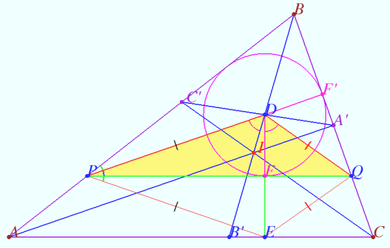
 and
and  be the bisectors of a triangle

 and
and  be the bisectors of a triangle
 - The segments
 and
and  meet at point
  Let
Let  be the projection of
  to
to 
- Points and
 on the sides
  and
and  respectively, are such that
- Prove that
 (Source)
 meet at point
  Let
Let 

 (
(- IMO 2007 Short list/G3

The diagonals of a trapezoid intersect at point
Point lies between the parallel lines and such that  and line separates points and
Prove that 
Proof

 and
and  are isogonals with respect

 is isogonal to with respect
From the converse of The isogonal theorem we get

vladimir.shelomovskii@gmail.com, vvsss This article is a stub. Help us out by expanding it.




